
How Many When (All Time)
/
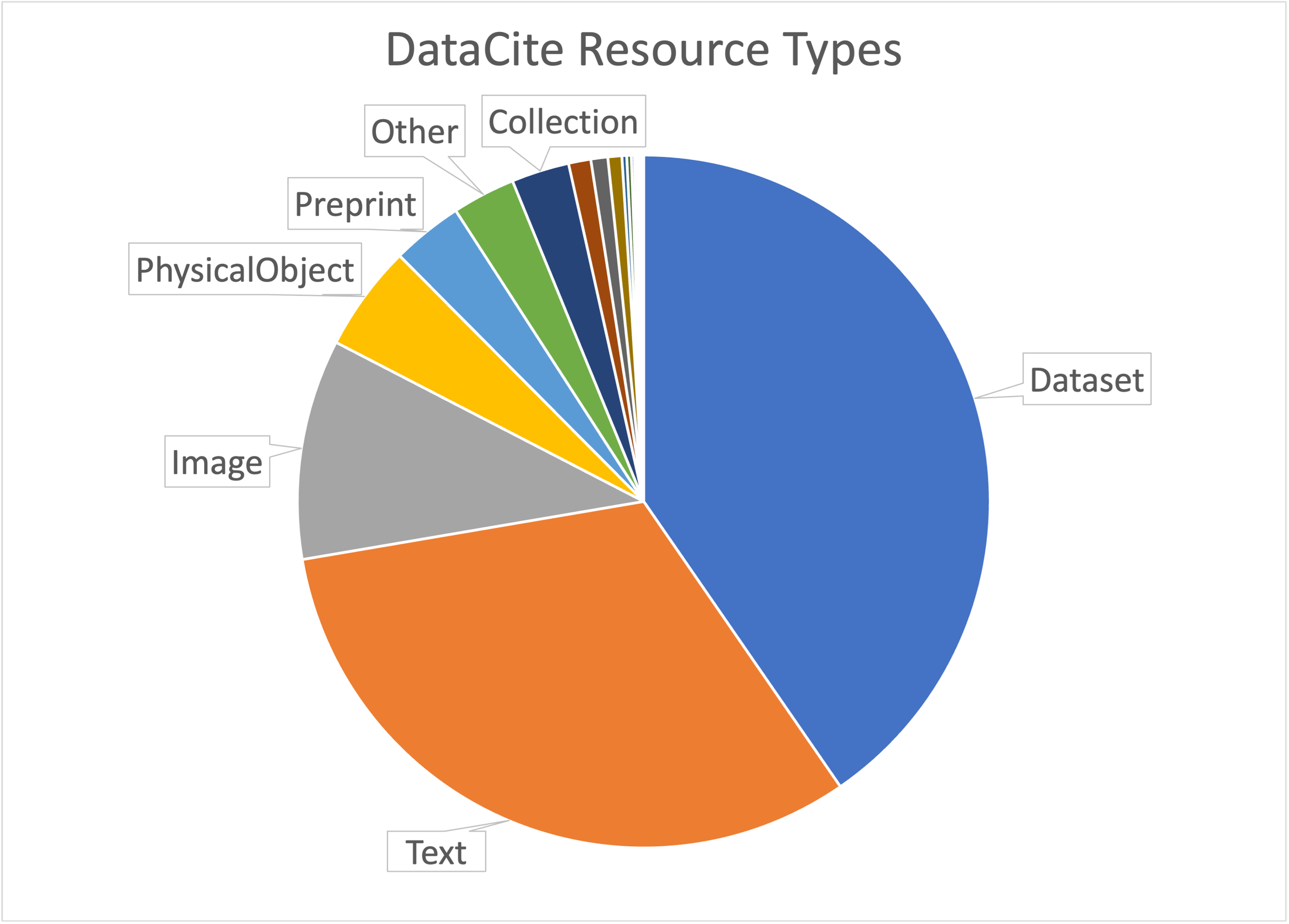
DataCite has a long history of registering DOIs for a variety of resource types.
Read MoreDataCite has a long history of registering DOIs for a variety of resource types.
Read MoreNeed facet data in a machine-readable format? The new option —facetdata can help!
Read MoreI will describe how the DataCite metadata facets help me improve my understanding of DataCite metadata usage in this blog and introduce some software that can help you answer your questions about DataCite metadata usage.
Read MoreThe idea that DataCite exists only to provide DOIs is deeply embedded in repository thought processes and this idea needs to evolve. The research community needs to think about DataCite (and other elements of the global research infrastructure) as powerful resources for describing and connecting the myriad of resources that make up the modern research world. We need to maximize the information that we add into this system to maximize the benefits we can get out of it.
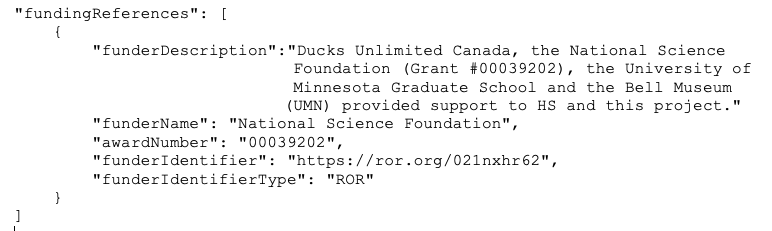
Read MoreImproving the completeness and the machine-readability of funder metadata in the global research infrastructure, i.e. DataCite and Crossref, is a critical step along the path of using that infrastructure to identify and characterize research results supported by funders all over the world. A set of 854 funder descriptions from the DRUM repository were processed into 1482 affiliation strings. ROR identifiers were found for 638 of those affiliations and 229 award numbers were extracted.
Read MoreIdentifying diverse contributions made to research objects is the first step in acknowledging those contributions. DataCite includes the contributorType metadata element and a list of twenty types to support this step. A type of Other is included to allow recognition of contributions not included in the list. Understanding how Other is used might help evaluate possible extensions to the contributorType list.
Read MoreWe are in the early days of documenting output management plans using DataCite metadata so it is an important time to identify and adopt common practices that help realize the exciting goals of machine-actionable DMPs. Common practices will facilitate the creation of interoperable DMPs and the development of tools across the research community that help us all reap the on-going benefits of these plans throughout the research life-cycle.
Read More“Existing metadata are an exciting learning set for discerning patterns that can be used to streamline the metadata creation process. We want to ensure that data are being submitted to the best fit repository with the right metadata. ”
Read MoreWriting out an acronym the first time you use it works well in technical writing. Use the same rule in your affiliations! Is it Metadata Game Changers or Mitsubishi Gas Chemical?
Read MoreCan communities around domain repositories be used to increase connectivity for researchers and organizations in those communities? The UNAVCO repository suggests that the answer is yes.
Read MoreCan metadata from journal articles be used to augment dataset metadata? Yes for affiliations, no for ORCIDs…
Read MoreMetadata metrics over the last five years demonstrate that communities and repositories can work together to improve metadata.
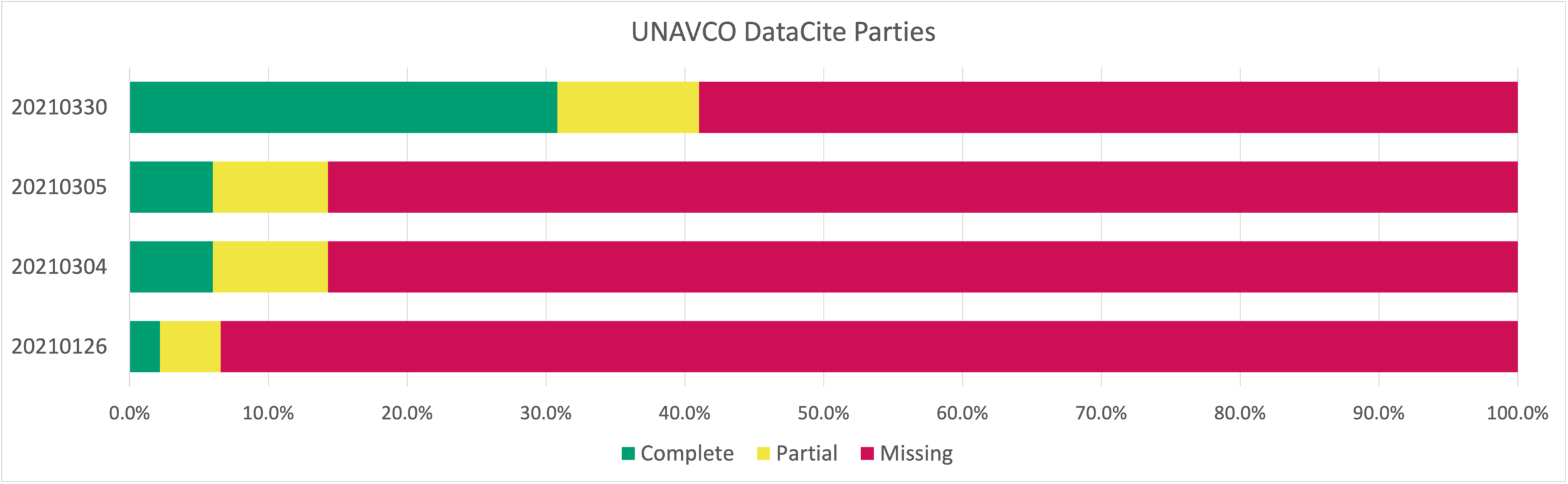
Read MoreThe UNAVCO community is the most common creator of datasets in the UNAVCO repository. They need to be recognized for those contributions. Adding an identifier for the community increases the % of DOIs with complete connectivity from 6 to 30%.
Read MoreAdding identifiers for organizations is an important step in the process of increasing connectivity in metadata collections. Organizations make many contributions to domain repositories so each identifier is used many times. In the UNAVCO case, thirty-five identifiers were used over two thousand times.
Read MoreDomain repositories build strong communities of people and organizations that contribute data, expertise and scientific results. These communities thrive on active connections between data, papers, people, and organizations. Multiple contributions and real-world connections make domain repositories great places for adoption of identifiers and virtual connections that build the PID graph.
Read MoreWe are thrilled to announce that Metadata Game Changers is partnering with Openscapes, housed at the National Center for Ecological Analysis and Synthesis on a new NASA-funded, three year project! The full announcement is posted to the Openscapes website here: https://www.openscapes.org/blog/2021/03/10/nasa-announcement/
Read MoreMeasuring metadata completeness is a great way to identify good examples and low-hanging fruit for improvement. A Pidapalloza talk from last week described results from a recent assessment of 144 repositories from the TIB DataCite Consortium with respect to recommendations for FAIR metadata. Overall, the seven mandatory DataCite fields dominate these repositories, but several great examples that go beyond the mandatory were identified.
Read MoreIn honor of PIDapalooza 2021 and 25 hours of Persistent Identifier discussion happening today, we thought a post celebrating the power of PIDs for increasing connectivity and how to measure that connectivity is in order. Let’s party on 🥳
Read MoreIt has been ten years since the release of the first DataCite metadata schema. Many improvements since then provide a roadmap for community evolution toward making DataCite metadata more FAIR.
Read MoreThe road to complete and consistent metadata can be long and arduous – digging through piles of metadata and other kinds of data to find small gems of information that can be added to metadata records, contacting recalcitrant researchers to fill in blanks, slowly building content across a collection… Does it really need to be that hard?
Read MoreI have worked in scientific data management for many years and enjoy working with organizations and communities that share data and knowledge. I am fluent in metadata standards and dialects used in scientific data management and publishing.
We are constantly working to help you change your metadata game. If you have any questions, suggestions, or crazy ideas, please send contact us or connect with us through the details below.
Ted Habermann
ted@metadatagamechangers.com
ORCID | LinkedIn | Twitter
Erin Robinson
erin@metadatagamechangers.com
ORCID | LinkedIn | Twitter
or use this form.
Search the site:
Powered by Squarespace.